Productivity · 203 lessons in the app

Productivity techniques, and where they come from

The two-minute rule, Parkinson's law, deep work and eating the frog. Each lesson names who came up with the idea, so you can tell a research finding from a writer's rule of thumb.

Try 4 lessons exactly as they appear in the app

Productivity35s read

Lesson 1 of 4

The Two-Minute Rule

David Allen's getting-things-done principle: if a task takes less than two minutes, do it immediately. Don't schedule it, don't add it to a list, just do it now. The rule eliminates the mental overhead of tracking dozens of tiny tasks that accumulate into cognitive clutter. Capture big tasks; eliminate small ones instantly.

Source Allen, D. (2001). Getting Things Done.

Quick quiz

You receive an email that will take 90 seconds to reply to. According to David Allen's two-minute rule, what should you do?


Productivity38s read

Lesson 2 of 4

Parkinson's Law

Work expands to fill the time available for its completion. Give yourself a week to write a report and it will take a week. Give yourself two hours and it will take two hours. Deadlines don't just create urgency, they reveal the minimum viable effort. The cure for Parkinson's Law: always constrain your time.

Source Parkinson, C.N. (1955). Parkinson's Law. The Economist.

Quick quiz

Your manager gives you two weeks to prepare a presentation that normally takes you three days. According to Parkinson's Law, what will most likely happen?

Productivity45s read

Lesson 3 of 4

Deep Work vs. Shallow Work

Cal Newport divides work into two types: deep work (cognitively demanding tasks requiring full focus, writing, coding, complex analysis) and shallow work (email, meetings, admin). The paradox: modern workplaces optimize for shallow work, constant availability, open offices, Slack pings, while deep work is what actually creates value.

Source Newport, C. (2016). Deep Work.

Quick quiz

You have 8 hours in the office. You spend 6 hours in meetings and on email, and 2 hours writing a strategic plan. According to Cal Newport, which block produced the most value?

Productivity35s read

Lesson 4 of 4

Eat the Frog

'If it's your job to eat a frog, it's best to do it first thing in the morning.' The line is often credited to Mark Twain, with no record that he said it. The frog is your hardest, most important task, the one you're most likely to procrastinate. Do it first, before email, before social media. The rest of the day feels easier once the hardest thing is done.

Source Tracy, B. (2001). Eat That Frog!

Quick quiz

The 'frog' in Brian Tracy's 'Eat That Frog' methodology represents what type of task?

199 more productivity lessons in the app

Every title here is a lesson in Scroll, with its own quiz. Five a day are free; Premium has no daily limit.

Download on the App StoreGet it on Google Play
  1. The Pomodoro Technique
  2. The Power of Saying No
  3. The 1% Better Rule
  4. The MIT Triple-Loop Learning
  5. Time Blocking: The Antidote to Reactive Work
  6. The Eisenhower Matrix
  7. Spaced Repetition: The Science of Retention
  8. The GTD Capture Habit
  9. Flow State: Optimal Experience
  10. The Power of Constraints
  11. Weekly Reviews: The Keystone Habit
  12. The 80/20 Rule Applied to Productivity
  13. Habit Stacking
  14. The Feynman Technique
  15. Deliberate Practice: How Expertise Is Built
  16. The Morning Routine
  17. Energy Management vs Time Management
  18. Inbox Zero: The Philosophy
  19. The Planning Fallacy
  20. The Maker's Schedule vs Manager's Schedule
  21. The Seinfeld Method: Don't Break the Chain
  22. Second Brain: Externalising Cognition
  23. The Ulysses Contract
  24. Managing Attention, Not Just Time
  25. The Hungry Judges Study
  26. The 5-Hour Rule: Deliberate Learning
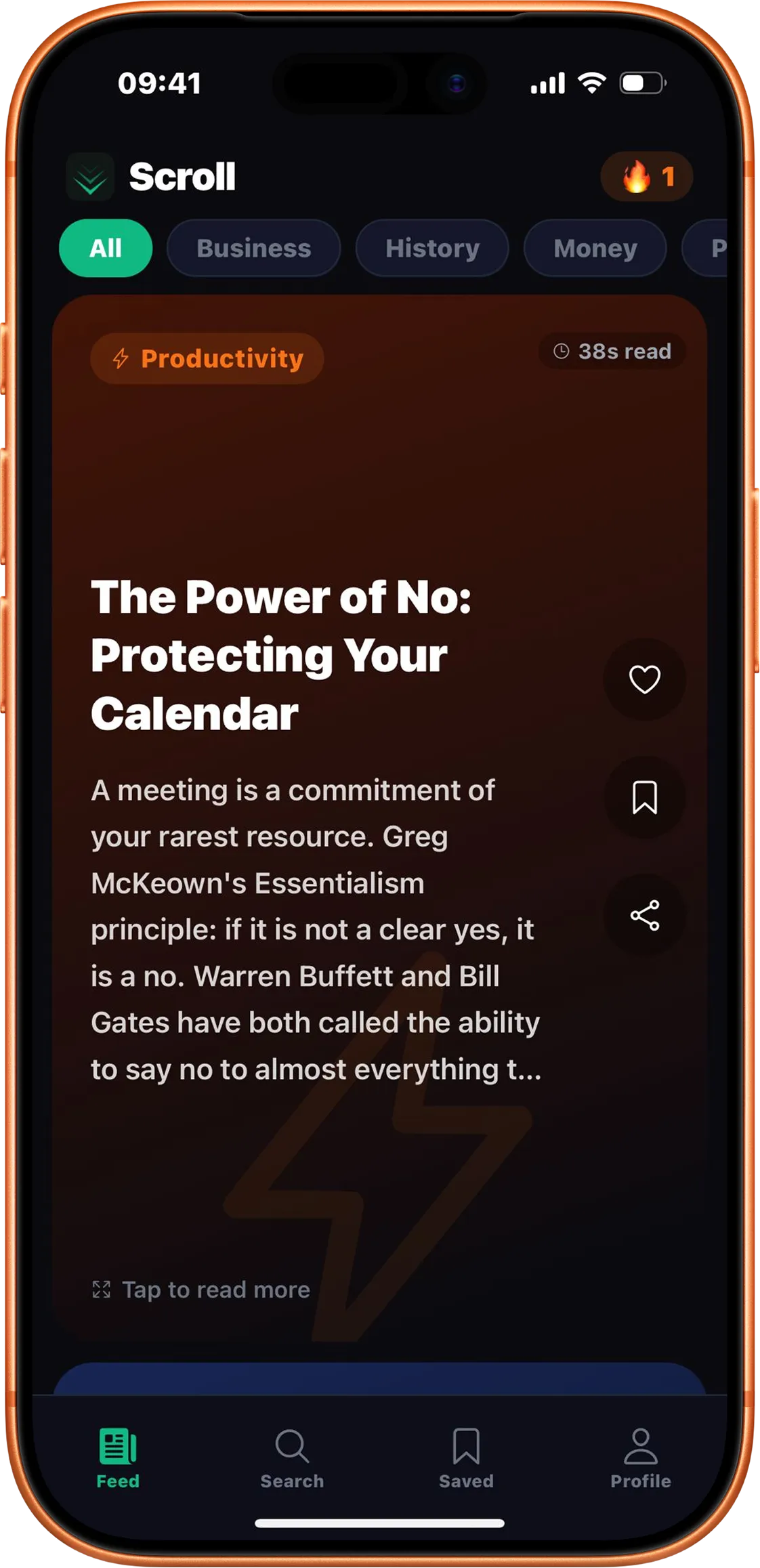
  27. The Power of No: Protecting Your Calendar
  28. Active Recall vs Passive Review
  29. Batching Similar Tasks
  30. The PARA Method for Organising Information
Show all 199 titles
  1. Multitasking Is Really Task Switching
  2. Outcome vs Output vs Activity
  3. The Ivy Lee Method
  4. The Cost of Perfectionism
  5. The Zeigarnik Effect: Use Incompletion
  6. The Single Most Important Task
  7. Automation: The Leverage Multiplier
  8. The Power of Rest: Strategic Recovery
  9. Procrastination: What It Really Is
  10. Goal Setting Theory
  11. The Minimal Viable Routine
  12. The Pre-Mortem Technique
  13. The Art of Delegation
  14. The Learning Loop: Build-Measure-Learn
  15. Mental Models: The Software for Your Mind
  16. The Rubber Duck Technique
  17. The Three Deep Work Strategies
  18. Interleaving: Mixing Topics to Learn Better
  19. Designing for Defaults
  20. The Curiosity Mindset
  21. The Power of Systems Over Goals
  22. The Zettelkasten Method
  23. Walking and Thinking
  24. The Minimum Effective Dose
  25. Writing as Thinking
  26. The Power of Environment Design
  27. Asymmetric Returns on Learning
  28. The Role of Sleep in Productivity
  29. The Two-Track System: Now and Later
  30. Pomodoro Breaks: What the Research Says
  31. Imposter Syndrome and Productivity
  32. The Art of Reading Well
  33. Feedback Loops: The Engine of Learning
  34. The Planning Horizon
  35. Context Switching Costs
  36. Working With Your Chronotype
  37. The Good Enough Standard
  38. First-Principles Thinking
  39. The Difference Between Busy and Productive
  40. Intrinsic vs Extrinsic Motivation
  41. The Personal Kanban
  42. The Importance of Unstructured Time
  43. The Socratic Method in Self-Coaching
  44. Kaizen: The Philosophy of Continuous Improvement
  45. Writing the First Draft
  46. The Concept of Slack
  47. The Journaling Practice
  48. The Bottleneck Principle
  49. The Diffuse Mode of Thinking
  50. The Aggregation of Marginal Gains
  51. The Power of Accountability
  52. The Art of the Productive Meeting
  53. The Completion Effect
  54. Saying No Gracefully
  55. The Power of Teaching What You Learn
  56. The Burnout Warning Signs
  57. Managing Creative Energy
  58. The Productivity Trap of Tools
  59. The Narrative Self and Productivity
  60. The Question of Priorities
  61. The Zettelkasten and Idea Compounding
  62. The Power of Habit Stacks in Morning Routines
  63. The Social Contract of Focus at Work
  64. Reading Faster Without Losing Comprehension
  65. The Five Whys Technique
  66. The Productive Life: What It's Really For
  67. The Four Laws of Behavior Change
  68. Keystone Habits
  69. The Habit Loop
  70. Identity-Based Habits
  71. Implementation Intentions
  72. Temptation Bundling
  73. The 66-Day Habit Formation Timeline
  74. Ultradian Rhythms and Peak Performance
  75. Strategic Caffeine Use
  76. The Role of Breaks in Sustained Performance
  77. First Things First: Roles and Goals
  78. The 12-Week Year
  79. The Power of a Shutdown Ritual
  80. Decision Fatigue and Simplifying Choices
  81. The Weekly and Daily Highlight
  82. Morning Pages: Clearing the Creative Channel
  83. The Diverge-Converge Creative Cycle
  84. Meeting Hygiene: The Cost of Gatherings
  85. Asynchronous Communication as a Superpower
  86. The Top-Five Priority Method
  87. Leverage Points: High-ROI Activities
  88. Growth Mindset vs. Fixed Mindset
  89. Emotional Regulation and Cognitive Performance
  90. The 5-Second Rule
  91. Visualization: The Mental Contrasting Method
  92. Notification Management
  93. Music and Cognitive Performance
  94. Standing Desks and Movement
  95. Natural Light and Circadian Alignment
  96. Single Workspace for Single Purpose
  97. Deep Questions Drive Better Work
  98. Digital Minimalism
  99. Using AI as a Productivity Amplifier
  100. Hydration and Cognitive Performance
  101. Nutrition and Focus: Blood Sugar Basics
  102. Zone 2 Cardio for Cognitive Longevity
  103. Principles-Based Decision Making
  104. Second-Order Thinking
  105. The Adjacent Possible
  106. Radical Candor: Feedback as Productivity
  107. Reflective Journaling for Performance
  108. The Art of Essentialism
  109. Warren Buffett's Inner Scorecard
  110. Slow Productivity: The Lost Art of Accomplishment
  111. The Consistency Principle: Show Up Every Day
  112. Attention Residue and Task Completion
  113. Proactive Versus Reactive Work Modes
  114. Self-Monitoring and Performance
  115. The Fresh Start Effect
  116. The Power of a Good Network
  117. Pyramid Principle: Structure Communication for Impact
  118. The Elements of Style: Clarity Over Complexity
  119. Nonviolent Communication in the Workplace
  120. Listening as Productivity
  121. Documentation as Force Multiplication
  122. The Art of the Clear Ask
  123. Presentation Design: Less is More
  124. Email as a Productivity Drain
  125. The Power of the Handwritten Note
  126. Storytelling as a Productivity Tool
  127. Ultralearning: Aggressive Self-Education
  128. Elaborative Interrogation for Deep Understanding
  129. Creating Systems for Generating Ideas
  130. Mind Mapping for Non-Linear Thinking
  131. Transfer of Learning Across Domains
  132. Heat Exposure and Brain Function
  133. Zone 4 and 5 Training for Mental Toughness
  134. Breathwork for Immediate State Change
  135. Non-Sleep Deep Rest (NSDR)
  136. Cold Plunge for Mental Resilience
  137. Social Connection as a Productivity Multiplier
  138. The 5 AM Club and Early Rising
  139. Strategic Disconnecting
  140. The Power of Contrast Experiences
  141. Boredom as a Creative State
  142. The Role of Mentors in Accelerated Learning
  143. The Peer Group Effect on Performance
  144. Feedback Loops: The Engine of Improvement
  145. The After-Action Review
  146. The Sprint: Solving Big Problems Fast
  147. Working in Public: The Accountability Dividend
  148. Principled Negotiation: Getting to Yes
  149. Persuasion: The Six Principles
  150. The Power of Questions
  151. Conscious Charisma: Presence as a Skill
  152. SCAMPER: A Framework for Creative Iteration
  153. Lateral Thinking and De Bono's Six Hats
  154. The Creative Confidence of IDEO
  155. The 3-3-3 Method
  156. The Ikigai Framework: Purposeful Productivity
  157. The Anti-Library: What You Don't Know
  158. The Regret of Omission
  159. Playing Infinite Games
  160. The Stockdale Paradox
  161. Time Affluence: The Feeling of Having Time
  162. Systems Thinking: Seeing the Whole
  163. Survivorship Bias and Productivity Advice
  164. Building Expertise Through Imitation
  165. Productive Disagreement: Steel-Manning
  166. Building a Personal Board of Directors
  167. The Craftsman Mindset
  168. The Medici Effect: Cross-Domain Innovation
  169. The Long Game: Building for the Future

About the productivity lessons

Where do the productivity ideas come from?

Some are research findings and some are rules of thumb from writers such as David Allen and Cal Newport. Each lesson names its source so you can tell which is which.

Your next scroll could teach you something.

Install Scroll free on iPhone or Android. 5 lessons a day cost nothing, and each takes about a minute.

Download on the App StoreGet it on Google Play

On a computer?Point your phone's camera here to open the right store.