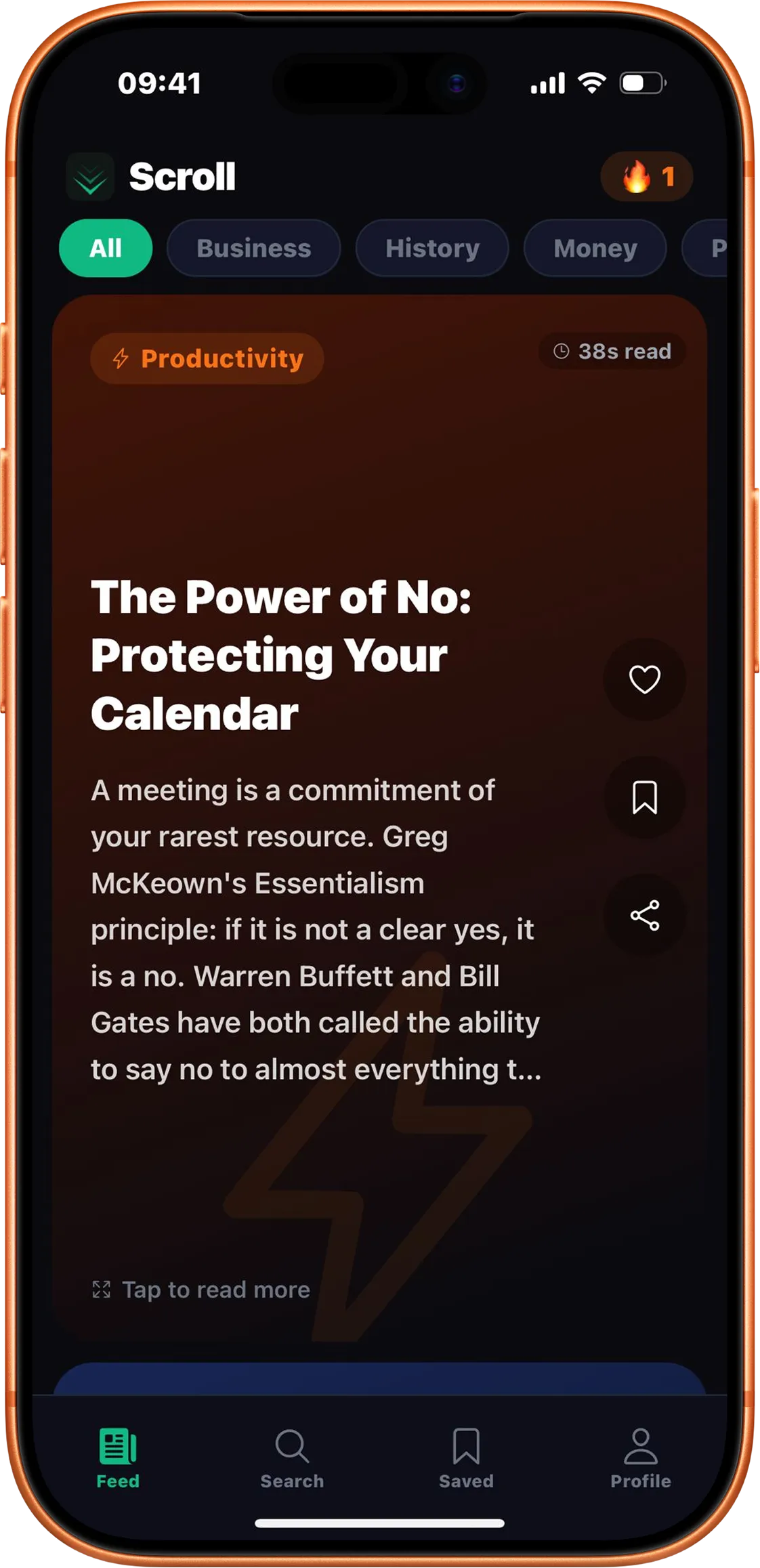
One idea in under a minute, then one question to check it went in. Scroll is a microlearning app with a feed of 1,700+ short lessons on psychology, history, science, money, tech and three more topics.
On a computer?Point your phone's camera here to open the right store.
5 free lessons every day
Every lesson cites its source
21 to 115 words a lesson
9:41
Scroll🔥1
AllHistoryMoneyPsychologyScience
45s read
Psychology
The Zeigarnik Effect
People remember unfinished tasks better than completed ones. Soviet psychologist Bluma Zeigarnik noticed this while watching waiters. They effortlessly recalled unpaid orders but forgot them the moment the bill was settled. Your brain keeps incomplete loops open, which is why unfinished to-do items stay on your mind.
35s read
History
The Origin of "OK"
The most widely recognized word on earth, "OK", likely originated in 1839 as a joke abbreviation of "oll korrect" (a deliberately misspelled "all correct") in a Boston newspaper. It exploded in popularity during the 1840 presidential campaign of Martin Van Buren, nicknamed "Old Kinderhook." Language, like culture, spreads through accidents.
38s read
Science
Why You Can't Tickle Yourself
Your cerebellum predicts the sensory consequences of your own movements and dampens responses to self-produced stimuli. When someone else tickles you, the touch is unexpected, triggering a startle response. The brain literally cancels your own touch before it reaches consciousness, a feature, not a bug.
35s read
Money
The Rule of 72
Divide 72 by your annual return rate to find how many years it takes to double your money. 72 ÷ 8% = 9 years to double. 72 ÷ 6% = 12 years. Works for debt too, a 24% credit card interest rate doubles your debt every 3 years. Quick, powerful, and requires no calculator.
0 of 4 right · 0 XP
That's the whole loop.
The app has 1,749 more lessons like these across eight topics. 5 a day are free.
People remember unfinished tasks better than completed ones. Soviet psychologist Bluma Zeigarnik noticed this while watching waiters. They effortlessly recalled unpaid orders but forgot them the moment the bill was settled. Your brain keeps incomplete loops open, which is why unfinished to-do items stay on your mind.
Deep Dive
Writers and filmmakers exploit the Zeigarnik Effect by ending chapters or scenes on a cliffhanger, compelling us to continue. You can use it productively: stop work mid-task so your brain keeps subconsciously working on the problem.
Zeigarnik, B. (1927). Über das Behalten von erledigten und unerledigten Handlungen.
#memory
#productivity
#brain
Quick Quiz
What did Bluma Zeigarnik discover about unfinished tasks and memory?
Scroll the phone. These are four real lessons from the app.
lessons, each with a quiz
1,700+
topics to pick from
8
lessons with a Deep Dive
360
free lessons a day
5
achievements to collect
42
How a lesson works
One idea, one question, about a minute
The feed looks like any other you scroll. The difference is what's on each card, and the question that comes after it.
01
Read one idea
Each card holds a single idea in 21 to 115 words, with the book, paper or record it comes from printed underneath. 360 lessons have a Deep Dive paragraph if you want more.
PsychologyThe Spotlight EffectGilovich, T., Medvec, V.H., & Savitsky, K. (2000). The spotlight effect in social judgment.
02
Answer one question
Four options, one right answer, and a line on why. Across all 1,753 quizzes the right answer is A, B, C or D about a quarter of the time each, so there's no pattern to guess from.
A25.0%
B24.6%
C25.6%
D24.9%
03
Keep the thread
Right answers earn XP. Reading on consecutive days builds a streak, and missing one resets the streak but keeps your XP and achievements. Save any lesson to come back to it.
MTWTFSS
Eight topics
Pick what you're curious about. Or don't, and let the feed mix it.
Choose your interests when you start and change them whenever you like. Each topic page below has a few lessons you can read and answer here.
In a 2006 experiment at Washington University in St. Louis, students read a short passage. Some then read it again; others wrote down what they remembered. A week later the recall group remembered more, although the rereaders had felt more confident they would.
A 2014 review of 159 such comparisons found the same pattern on average, with a bigger gain when people saw the right answer afterward. That's why every Scroll lesson ends with a question and an explanation, instead of a "got it" button.
What this doesn't show: the studies used students and lab tasks, and the effect varied a lot between them. Nobody has tested Scroll itself, so we don't claim it will make you remember more.
Share of a passage recalled one week later
Read once, then recalled it56%
Read it twice42%
After five minutes the rereaders were ahead (81% to 75%). The advantage of recall showed up later.
Ten minutes rarely feels like time worth planning. Added up over a year, it's about 61 hours. Scroll is built for those same few minutes: open it where you'd open a feed, and close it a minute later knowing one more thing.
On the free plan (5 a day) that's 1,825 lessons a year. Premium removes the daily cap.
How the lessons are made
Short doesn't have to mean vague
A one-minute lesson has no room for padding, so each one is held to a few rules you can check for yourself in the app.
Lessons that name their source
1,753 of 1,753
The oldest is Luca Pacioli's maths textbook of 1494, behind the lesson "The Rule of 72". 118 cite work published in 2020 or later.
Right answer in each position
A 25.0% · B 24.6% · C 25.6% · D 24.9%
Four plausible options per question, spread evenly, so the quiz checks the idea rather than your luck.
Words per lesson
21 to 115
One idea, one example, then stop. 360 lessons add a Deep Dive paragraph for people who want more.
A full lesson, as writtenPsychology · 40s
Anchoring Bias
The first number you hear sets an invisible anchor. In negotiations, whoever names a price first shapes the entire conversation. Judges given random numbers before sentencing give harsher or lighter sentences accordingly. Your brain uses the anchor as a reference point even when it is completely irrelevant.
Source Tversky, A., & Kahneman, D. (1974). Judgment under Uncertainty: Heuristics and Biases.
Prices
Free to start. One small price if you want more.
The free plan doesn't expire. It stops at five lessons a day, and the counter resets at midnight.
US App Store prices, checked October 17, 2026. Apple and Google set local prices in other countries, and the app shows yours before you pay. Cancel any time in your App Store or Google Play subscriptions; Premium then lasts until the end of the period you paid for.
Questions people ask before installing
What is microlearning?
Learning in very small pieces: one idea at a time, in a few minutes or less, usually with a quick check at the end. Scroll applies it to general knowledge, with lessons of 21 to 115 words and one question after each.
How long does a lesson take?
About a minute with the question. The app lists 32 to 50 seconds of reading per lesson, and answering takes a few seconds more.
Is Scroll free?
Yes. The free plan gives you 5 lessons a day with no end date. Premium ($3.99 a month or $19.99 a year in the US) removes the daily limit.
What topics does it cover?
Psychology, Tech & Internet, Business, Money, History, Science, Philosophy and Productivity. You pick your interests when you start and can change them any time from your profile.
How do streaks work?
Read at least one lesson on consecutive days to extend your streak. If you miss a day the streak resets, but your XP, achievements and progress stay.
How do I cancel Premium?
Through the store you bought it from. On iPhone: App Store, your profile, Subscriptions, Scroll. On Android: Google Play, your profile, Payments and subscriptions, Subscriptions, Scroll. Premium lasts until the end of the period you paid for.
Does it work on iPad?
Yes. Scroll runs on iPhone and iPad with iOS 15.1 or later, and on Android phones from Google Play.
Your next scroll could teach you something.
Install Scroll free on iPhone or Android. 5 lessons a day cost nothing, and each takes about a minute.
On a computer?Point your phone's camera here to open the right store.

 Scroll